Contrary to what you might believe, you don’t just wake up one day and suddenly “enter perimenopause”. Instead, things begin to feel off slowly, but surely. Subtle at first, then harder to ignore. Your energy shifts, your mood feels less predictable, your sleep changes, and your body starts responding differently to things that never used to be an issue.
And here’s what I see time and time again in practice: women are told this is stress, or that they’re just busy, or that this is what getting older feels like. But the reality is, perimenopause is a physiological transition driven by hormonal fluctuations, and those fluctuations affect far more than just your cycle.
So if you’ve been feeling like your body is changing in ways you don’t fully understand, you’re not imagining it, and you’re certainly not alone. Let’s break down what’s actually happening.
What is Perimenopause, Really?
Perimenopause is the phase leading up to menopause, and it can begin earlier than most women expect, often in the mid to late 30s, though for some it starts even sooner. It is not defined by a single moment, but by a gradual shift in hormone production, particularly estrogen and progesterone, which begin to fluctuate rather than follow a predictable rhythm.
This fluctuation is key, because it means your hormones are not simply “declining” in a straight line. They are moving up and down, sometimes dramatically, which is why symptoms can feel inconsistent, confusing, and difficult to track. One month you feel fine, the next you don’t recognize yourself.
And because these hormones influence everything from your brain to your metabolism, the ripple effect can show up across your entire body and across various symptoms in ways that you didn’t realise could happen at all.
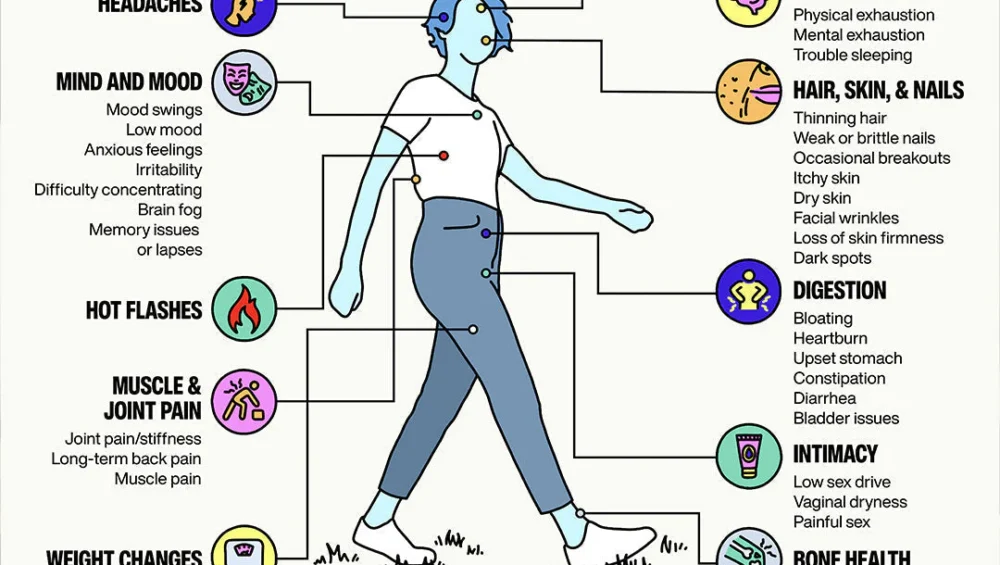
The Most Common Perimenopause Symptoms
Now, while every woman’s experience is different, there are patterns I see repeatedly, and once you understand them, things start to make a lot more sense.
1. Changes in your cycle
This is often the first noticeable sign for some women. Your periods might become heavier, lighter, closer together, or further apart, and for many, PMS becomes more intense than it was in your 20s. This is largely due to progesterone declining earlier than estrogen, creating a relative imbalance.
2. Mood swings, anxiety, and irritability
If you’ve found yourself feeling more reactive, more anxious, or less emotionally resilient than usual, there is a hormonal component to this. Estrogen interacts closely with neurotransmitters like serotonin and dopamine, so when it fluctuates, your mood often follows.
3. Sleep disturbances
You might fall asleep easily but wake up at 2 or 3am, wide awake, or struggle to stay asleep through the night. This is often linked to cortisol patterns, blood sugar instability, and declining progesterone, which normally has a calming, sleep-supportive effect.
4. Fatigue that doesn’t improve with rest
This is a big one. You sleep, you rest, you try to take care of yourself, yet the fatigue lingers. This is where hormones, stress physiology, and mitochondrial function all intersect, and it’s rarely as simple as “getting more sleep.”
5. Weight changes, especially around the midsection
You may notice that your body composition shifts, even if your habits haven’t. This is often tied to insulin sensitivity, cortisol, and changes in how your body stores and utilizes energy as estrogen fluctuates.
6. Brain fog and poor focus
Many women describe this as feeling slower, less sharp, or struggling to concentrate. Again, estrogen plays a role in brain energy metabolism, so when it shifts, cognitive function can feel affected.
7. Skin and hair changes
Skin may become drier, thinner, or more sensitive, and hair thinning can occur. These changes are directly linked to declining estrogen and shifts in androgen balance.
8. Hormonal acne
Yes, this can come back, even if you thought you left it behind years ago. Hormonal fluctuations, particularly relatively higher androgens, can trigger breakouts, often along the jawline and lower face.
Why Symptoms Feel So Unpredictable
One of the most frustrating parts of perimenopause is not just the symptoms themselves, but how inconsistent they feel. You might have a good week, followed by a difficult one, and it’s hard to identify what changed.
This is because hormones during this phase are not stable. Estrogen can spike, then drop, progesterone steadily declines, and cortisol often increases in response to stress, which is already higher for many women balancing careers, families, and everything else on their plate.
So what you’re feeling is not random, it’s a dynamic, shifting internal environment, and your body is responding to it in real time.
The Role of Stress, Blood Sugar, and Lifestyle
Here’s where everything links together.
If your blood sugar is unstable, meaning you’re skipping meals, relying on caffeine, or eating in a way that causes spikes and crashes, your cortisol will rise to compensate. Elevated cortisol then impacts estrogen and progesterone balance, making symptoms worse.
Add chronic stress, poor sleep, and a lack of recovery, and you create the perfect environment for symptoms to intensify.
This is why perimenopause is not just about hormones, it’s about how your entire system is functioning together.
What Actually Helps During Perimenopause
This is the part most women are looking for, and it’s also where nuance matters.
First, you need to understand what’s happening in your body, not guess. Hormone testing, when done properly, can provide insight into patterns that symptoms alone cannot explain. I created a full hormone testing kit that includes testing for all the menopause biomarkers you need to measure. It’s available in my shop if you want something comprehensive and tailor-made for exactly what perimenopausal women need.
Second, support needs to be foundational, not extreme. This includes:
• Eating in a way that stabilizes blood sugar, with adequate protein, fats, and fiber
• Prioritizing sleep and creating a consistent wind-down routine
• Managing stress through practices that regulate your nervous system
• Supporting gut health, which plays a role in hormone metabolism
• Strength training to maintain muscle mass and metabolic health
And third, it’s about consistency. Not perfection, not drastic changes, but steady, supportive habits that align with what your body needs in this phase.
The Part No One Tells You
Perimenopause is often framed as something to “get through,” but I don’t see it that way.
What I see is a phase that asks you to understand your body on a deeper level, to stop pushing through symptoms, and to start working with your physiology instead of against it.
Because once you understand what’s happening, the confusion lifts, and you’re no longer reacting to symptoms, you’re responding to them with clarity.
To Sum Up
If your body feels different, there is a reason.
If your symptoms feel confusing, there is a pattern.
And if you’ve been told everything is “fine” but you don’t feel fine, it’s worth looking deeper.
Perimenopause is not the problem. Lack of understanding and education surrounding it is. By being here, you are breaking that down and taking the first step necessary to start taking control of your perimenopause symptoms.
Don’t forget to explore more of my blog posts and reach out if you have any questions.